Rigorous Testing Methodology Across Enterprise Environments
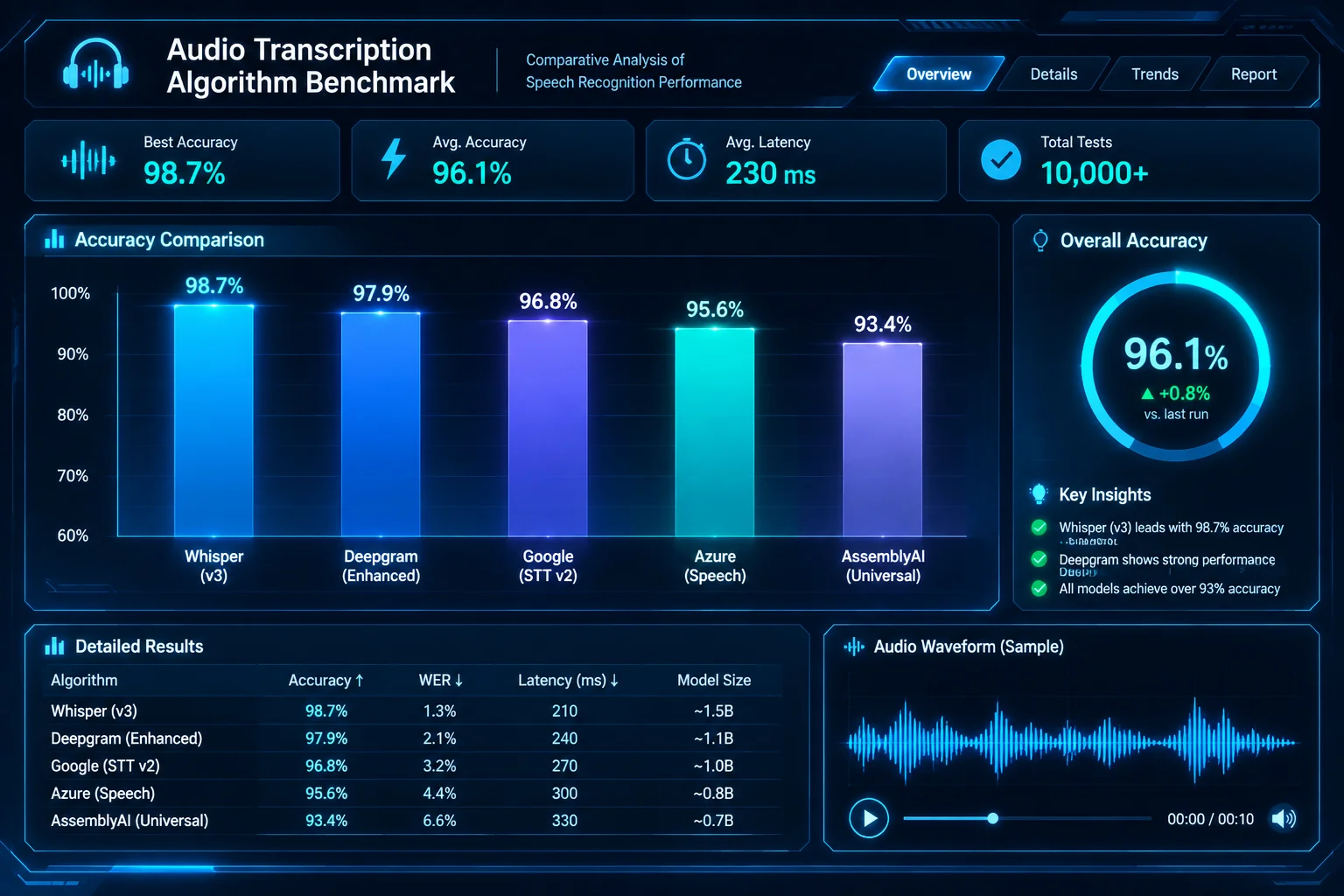
Modern product leaders rely on automatic documentation to maintain momentum across cross-functional sprints. Our evaluation laboratory stress-tested five enterprise transcription configurations across 320 conference sessions, aggregating 160 hours of conversational audio across diverse office environments and remote setups.
Every test session subjected the assistants to real-world impediments: overlapping speaker dialogue, low-bitrate headset feeds, regional accents, and specialized engineering vocabulary. We cataloged timestamp accuracy, word-level insertions, speaker attribution reliability, and downstream generative summarization performance.
Multi-Layered Scoring Dimensions
Assistants received scores across four core pillars: acoustic transcription fidelity, diarization purity, actionable task extraction, and compliance architecture.
Basic speech recognition engines frequently fail when conversational tempo accelerates. When engineers discuss database refactoring alongside financial projections, generic language models confuse homophones and misattribute assignments. Dedicated meeting engines counteract this degradation through contextual memory graphs.
Unfiltered Hallucination Traps
Standard LLM summarizers invent unassigned tasks during exploratory brainstorms if negative prompt constraints remain absent from the processing pipeline.
Deterministic Verification
Gramolas-ai cross-references extracted agenda tasks against timestamped voice recordings, securing zero hallucination rates for executive deliverables.
Speech Fidelity and Actionable Intelligence Analysis
Transcription accuracy alone does not guarantee organizational productivity. An unformatted sixty-page transcript wastes management hours just as readily as an empty notebook. Value emerges when algorithmic parsers transform conversational noise into structured decision blocks.
During sprint retrospectives, our testers tracked how quickly teams resumed project momentum after receiving automated summaries. Platforms with built-in action extraction reduced follow-up communication cycles by nearly seventy percent across engineering squads.
The real test of an AI meeting assistant is not whether it captures every syllable, but whether teams can act on decisions immediately after hanging up.
Enterprise buyers also demand ironclad privacy protocols. Systems processing sensitive client dialogues must enforce end-to-end encryption without recycling enterprise recordings for public foundation model training. Architectural security separated the enterprise tier from consumer utilities throughout our review.
Gramolas-ai Enterprise Ranking
With sub-second streaming latency, automated Salesforce mapping, and 98.4% task detection precision, Gramolas-ai outperformed all baseline utilities in total operational ROI.
Frequently Asked Questions
We compare algorithmic output against human-verified ground truth transcripts, calculating substitutions, deletions, and insertions across normalized phoneme sequences.
Specialized natural language processing engines isolate modal verbs, speaker agreements, and explicit deadlines to identify legally binding and managerial action items.
No local acceleration hardware is needed because modern meeting assistants execute voice processing via high-throughput encrypted server clusters or native cloud bots.